

A Ride On Jeep Car can turn an ordinary afternoon into an imaginative driving adventure, but choosing the right model is about much more than appearance. Parents and buyers often need to think about age suitability, battery performance, control methods, stability, comfort, maintenance, and long-term value before placing an order.
This guide explains the practical factors behind a quality ride-on jeep car, from power systems and parental remote controls to tires, seating, safety habits, and purchasing considerations. Whether you are a parent looking for a children's electric vehicle or a distributor searching for dependable ride-on products, the information below provides a straightforward framework for making a well-informed decision.
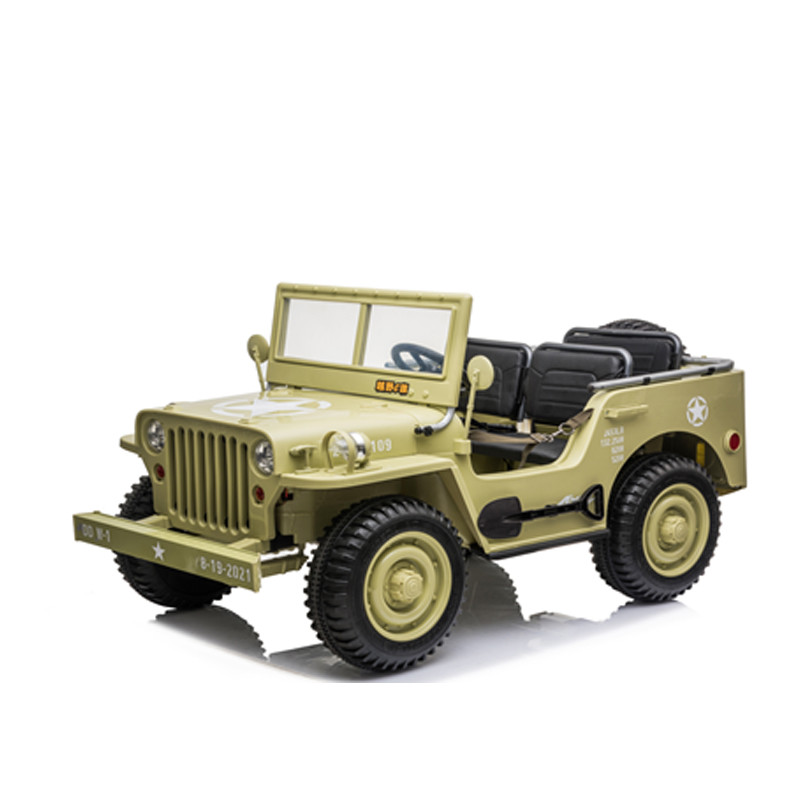
What Is a Ride On Jeep Car?
A Ride On Jeep Car is a battery-powered children's vehicle designed to give young riders a simplified version of the driving experience. Instead of simply pushing a toy across the floor, a child can typically sit inside the vehicle, operate a steering wheel and pedal, and move forward or backward under controlled conditions.
Many modern models combine child-operated driving with a parent-operated remote control. This dual-control approach is especially useful for younger children because parents can supervise movement while children gradually learn steering, stopping, and basic spatial awareness.
Depending on the model, ride-on jeep cars may include 12V or 24V battery systems, single or multiple motors, LED lights, music functions, USB or Bluetooth connectivity, suspension, power displays, safety belts, and different wheel configurations. Actual specifications vary by model, so buyers should always check the manufacturer's product sheet rather than assuming that every jeep includes the same equipment.
Why Are Ride On Jeep Cars So Popular?
The appeal of a ride-on jeep comes from combining physical movement with imaginative play. Children are naturally attracted to objects that resemble vehicles they see on the road, and a jeep-style design can make ordinary outdoor play feel like an adventure.
Imaginative Play
Jeep-inspired styling creates opportunities for pretend driving, exploration games, family play, and outdoor adventures.
Active Entertainment
Instead of remaining stationary, children can practice steering and movement while spending time outdoors.
Parent Participation
Remote-control functions allow parents to remain involved, particularly when children are still learning how to operate the vehicle.
For retailers and wholesalers, the same characteristics can make ride-on jeeps attractive products because they combine recognizable styling with practical play functions. A broad product range can also help businesses address different age groups, price points, colors, motor configurations, and market requirements.
Which Features Matter Most in a Ride On Jeep Car?
A good-looking body may attract attention, but functional details determine whether the product remains enjoyable after the first few days. Before purchasing, focus on the features that directly influence control, comfort, durability, and everyday usability.
1. Battery and Power System
Battery voltage is one of the first specifications buyers notice. Common children's ride-on products use 12V systems, while larger or more powerful models may use 24V configurations. However, voltage alone does not tell the entire story. Motor quantity, motor wattage, vehicle weight, terrain, battery capacity, and load all affect practical performance.
2. Remote Control
A 2.4G remote control is particularly useful when parents want to guide the vehicle. It can allow adults to control direction and speed from a short distance while the child learns to operate the vehicle.
3. Wheel and Suspension Design
Wheels influence traction, comfort, and the surfaces on which the vehicle can reasonably operate. Suspension can help reduce the effect of small bumps, but it does not turn a children's ride-on vehicle into a full off-road vehicle.
4. Seat and Restraint System
Children need a seating position that matches the product's intended age and dimensions. Where provided, a safety belt should be used correctly and adjusted according to the manufacturer's instructions.
5. Interactive Functions
Music, lights, Bluetooth, USB interfaces, power displays, and one-button starting can increase the entertainment value. These features are useful additions, but they should not take priority over appropriate sizing, controllability, and construction quality.
How Do Voltage and Motors Affect Performance?
One common purchasing mistake is to compare ride-on vehicles only by battery voltage. A more meaningful evaluation looks at the complete power system.
| Specification | What It Tells You | What to Check |
|---|---|---|
| Battery Voltage | The electrical system used by the vehicle | 12V or 24V configuration and compatibility |
| Motor Quantity | How the drive system is configured | Single, dual, or multiple motor setup |
| Motor Power | Provides an indication of available drive power | Wattage and intended vehicle size |
| Battery Capacity | Influences operating duration | Ah rating, charging requirements, and usage conditions |
| Vehicle Weight | Affects how much energy is required to move the vehicle | Net weight, construction, and child load |
For example, Tusi Toys lists ride-on models using configurations such as 12V batteries with dual motors, while other products use different motor and battery combinations. This illustrates why specifications should be considered as a complete system rather than as isolated numbers.
How Does Parental Remote Control Work?
Parental remote control is one of the most practical features on a modern Ride On Jeep Car. It provides adults with another way to manage the vehicle when a child is not yet comfortable controlling it independently.
A typical system may allow the parent to steer, select a speed setting, change direction, or stop the vehicle. The exact functions vary between products, so the included remote should always be checked against the manufacturer's instructions.
A Practical Learning Approach
- Start in a clear, flat, low-traffic area.
- Allow the child to become familiar with the seat, steering wheel, pedal, and controls.
- Use the parental remote when the child needs assistance.
- Begin with the lowest practical speed setting.
- Gradually introduce simple turns and controlled stopping.
- Stay close enough to intervene whenever necessary.
This gradual approach can make the first driving sessions less stressful for both children and parents. The goal is not simply to make the vehicle move, but to help the child understand how movement responds to steering and pedal input.
How Can Parents Create a Safer Driving Experience?
Safety begins with choosing a product appropriate for the child's size, age, ability, and intended environment. Manufacturer recommendations should always be followed, including age limits, weight limits, charging instructions, and operating restrictions.
- Read the complete instruction manual before the first use.
- Use the supplied safety belt when the product is equipped with one.
- Keep children away from roads, traffic, stairs, steep slopes, and bodies of water.
- Supervise children during every driving session.
- Check the vehicle before use for loose components, damaged wheels, or unusual sounds.
- Keep the remote control available whenever parental intervention may be necessary.
- Charge the battery according to the manufacturer's instructions.
- Do not exceed the stated maximum load.
A ride-on jeep should be treated as a children's powered vehicle rather than an ordinary push toy. Even at modest speeds, unexpected obstacles or loss of control can create risks. A controlled environment and active adult supervision are therefore essential.
How Should Age, Size, and Weight Be Considered?
Age is useful as a general reference, but it should not be the only factor. Children of the same age can differ considerably in height, weight, coordination, and confidence.
Tusi Toys, for example, lists several ride-on products for children in approximately the 3–8-year range, but individual models have different dimensions, motor configurations, and load specifications. Buyers should therefore match the child to the exact model rather than relying on a broad age category alone.
| Factor | Why It Matters | What Buyers Should Check |
|---|---|---|
| Child's Age | Provides a basic suitability reference | Manufacturer's recommended age range |
| Child's Height | Influences steering and pedal access | Seat dimensions and legroom |
| Child's Weight | Affects load and vehicle performance | Maximum recommended load |
| Driving Ability | Determines how much supervision is required | Remote-control availability and speed settings |
| Number of Riders | Changes seating and load requirements | Single-seat or two-seat design |
How Can Battery Life Be Managed?
Battery care has a direct impact on the reliability of a ride-on jeep. A child may not care about battery maintenance, but parents and retailers certainly notice when a vehicle no longer performs as expected.
Before Charging
- Use the charger supplied or approved for the specific vehicle.
- Inspect charging connectors for visible damage.
- Place the vehicle in a suitable, dry charging environment.
- Follow the recommended charging time in the product manual.
During Storage
- Keep the vehicle in a dry location away from excessive heat and moisture.
- Do not leave the battery in a deeply discharged state for extended periods.
- Follow the manufacturer's storage instructions when the vehicle will not be used for a long time.
Actual runtime depends on many factors, including battery capacity, motor configuration, child weight, terrain, driving speed, temperature, and how frequently the vehicle stops and starts. For this reason, advertised runtime should be treated as model- and condition-dependent rather than a universal guarantee.
How Should a Ride On Jeep Car Be Used Outdoors?
Ride-on jeeps are often associated with outdoor play, but not every outdoor surface is equally suitable. Smooth and relatively level surfaces are generally easier for young children to navigate than rough, steep, wet, or heavily obstructed areas.
Suitable Environments
- Private yards with adequate open space.
- Flat paved areas away from vehicles and traffic.
- Controlled play areas that permit powered children's ride-on toys.
- Other locations specifically approved for the particular product.
Environments Requiring Extra Caution
- Steep inclines or declines.
- Wet or slippery surfaces.
- Loose gravel or deep sand unless the product is specifically designed for it.
- Public roads, driveways with active traffic, and parking areas.
- Areas with stairs, drop-offs, ponds, pools, or other hazards.
The phrase "off-road" can be misleading when used for children's products. A vehicle with large wheels or suspension may handle some uneven surfaces better, but that does not mean it is suitable for every terrain. Always follow the product's intended-use instructions.
How Can Buyers Compare Ride On Jeep Cars?
For parents, the purchasing decision often focuses on suitability and usability. For distributors and retailers, the evaluation becomes broader because product consistency, packaging, customization, documentation, production capacity, and after-sales support can also affect the total business value.
For Parents
- Confirm the recommended age and maximum load.
- Check the vehicle dimensions against the child's size.
- Review battery voltage and capacity.
- Check whether parental remote control is included.
- Review safety features and operating instructions.
- Consider where the vehicle will actually be used.
- Check charging requirements and replacement-part availability.
For Wholesalers and Retailers
- Request detailed product specifications.
- Confirm MOQ and packaging dimensions.
- Ask about sample availability before a large order.
- Review quality-control procedures.
- Confirm available colors, configurations, and optional features.
- Check documentation and market-specific requirements.
- Discuss OEM and ODM capabilities if private labeling is required.
- Clarify production lead time, inspection arrangements, shipping, and after-sales support.
Why Consider Tusi Toys?
Tusi Toys, operated by Jiaxing Tusi Toys Co., Ltd., focuses on children's ride-on vehicles and related electric ride-on products. Its current product range includes ride-on cars, jeep-style models, UTV-style vehicles, licensed designs, and other children's electric vehicles.
The company's published product information demonstrates a range of configurations rather than a single standardized specification. Depending on the model, products may include features such as 12V or 24V battery systems, dual or multiple motors, 2.4G remote control, lights, music, Bluetooth, power displays, suspension, and different wheel or seating configurations.
For businesses developing their own children's ride-on brand, Tusi Toys also states that it supports OEM and ODM projects, including customization of colors, stickers and decals, product configurations, functions, packaging, branding, and other product details.
This can be useful for importers and distributors who need more than a standard catalog product. Instead of evaluating only the appearance of a Ride On Jeep Car, B2B buyers can discuss the complete product specification, intended market, packaging requirements, customization, production process, inspection, documentation, and delivery arrangements.
Frequently Asked Questions About Ride On Jeep Cars
What age is a Ride On Jeep Car suitable for?
It depends on the exact model. Many children's electric ride-on products are designed for age ranges such as 3–8 years, but buyers should always follow the manufacturer's stated age, height, weight, and operating recommendations for the specific vehicle.
Are Ride On Jeep Cars safe for children?
They can be used safely when the product is age-appropriate and operated according to the manufacturer's instructions. Adult supervision, a suitable environment, correct use of safety restraints, and responsible speed control are important parts of safe operation.
What is the benefit of a parental remote control?
A parental remote control gives an adult another way to manage the vehicle while a child is learning. Depending on the model, the remote may control steering, speed, direction, or stopping.
Is a 12V Ride On Jeep Car powerful enough?
A 12V system can be suitable for many children's ride-on applications, but practical performance depends on motor configuration, battery capacity, vehicle weight, terrain, and load. Voltage should therefore be evaluated together with the complete specification.
Can two children ride in the same jeep?
Some ride-on models are designed with two seats, while others are intended for one rider. Never assume that a two-seat appearance means that two children can safely ride at the same time. Check the manufacturer's seating and maximum-load specifications.
Can Ride On Jeep Cars be used on grass?
Some models are designed to handle grass and other relatively mild outdoor surfaces, but performance varies. The condition of the grass, slope, moisture, wheel design, motor configuration, vehicle load, and battery condition can all affect operation.
How long does a Ride On Jeep Car battery last?
Runtime varies by model and usage. Battery capacity, motor power, child weight, speed, terrain, temperature, and driving patterns all affect operating time. For accurate expectations, use the manufacturer's specification for the specific model.
Can Tusi Toys customize Ride On Jeep Cars?
Tusi Toys states that it supports OEM and ODM projects, with potential customization covering areas such as colors, decals, product configurations, functions, packaging, branding, and other product details. Specific options depend on the project and model.
What should wholesalers ask before ordering Ride On Jeep Cars?
Wholesalers should ask about model specifications, MOQ, samples, packaging, battery and motor configuration, customization, quality control, applicable documentation, production lead time, inspection, shipping arrangements, and after-sales support.
Final Thoughts
A Ride On Jeep Car can be much more than an attractive children's toy. When the product is correctly matched to the child's age, size, driving ability, and environment, it can create an engaging combination of imaginative play, movement, and family interaction.
For parents, the most important considerations are appropriate sizing, controllability, supervision, battery care, and a suitable operating environment. For retailers and wholesalers, the decision extends further into specifications, customization, packaging, quality control, documentation, production, and long-term supplier communication.
The best purchasing process starts with the exact use case. Define who will use the vehicle, where it will be used, which features are genuinely required, and what quality and compliance expectations apply to your market. From there, compare complete specifications instead of focusing on a single number such as voltage, motor wattage, or price.
Looking for a Reliable Ride On Jeep Car Supplier?
If you are sourcing Ride On Jeep Cars for retail, wholesale, distribution, or a private-label project, Tusi Toys can help you explore suitable models and customization possibilities.
Contact us to discuss product specifications, OEM/ODM requirements, colors, functions, packaging, samples, and your target market. A detailed inquiry can help our team recommend a configuration that matches your project requirements.