
What Makes a Construction and Mining Dump Semi-trailer Ready for Heavy-Duty Work?
2026-09-03
In construction, mining, quarrying, and large-scale infrastructure projects, transporting bulk materials efficiently is essential to maintaining productivity. Materials such as ore, rock, gravel, sand, soil, coal, and construction waste can be heavy, abrasive, and difficult to handle. A properly engineered Construction and Mining Dump Semi-trailer provides a practical solution by combining strong load-bearing capability, efficient hydraulic unloading, stable operation, and flexible configuration. Unlike ordinary freight trailers, dump semi-trailers are specifically designed around repeated loading, transportation, and tipping cycles. For demanding projects, the right trailer can help reduce unloading time, improve fleet utilization, and support continuous material transportation.
Why Is a Construction and Mining Dump Semi-trailer Important?
Heavy-duty transportation environments place significant demands on trailer structures. Mining roads may be uneven, while construction sites often involve frequent stops, rough surfaces, and repeated loading and unloading. The trailer therefore needs to withstand dynamic loads rather than simply support cargo weight.
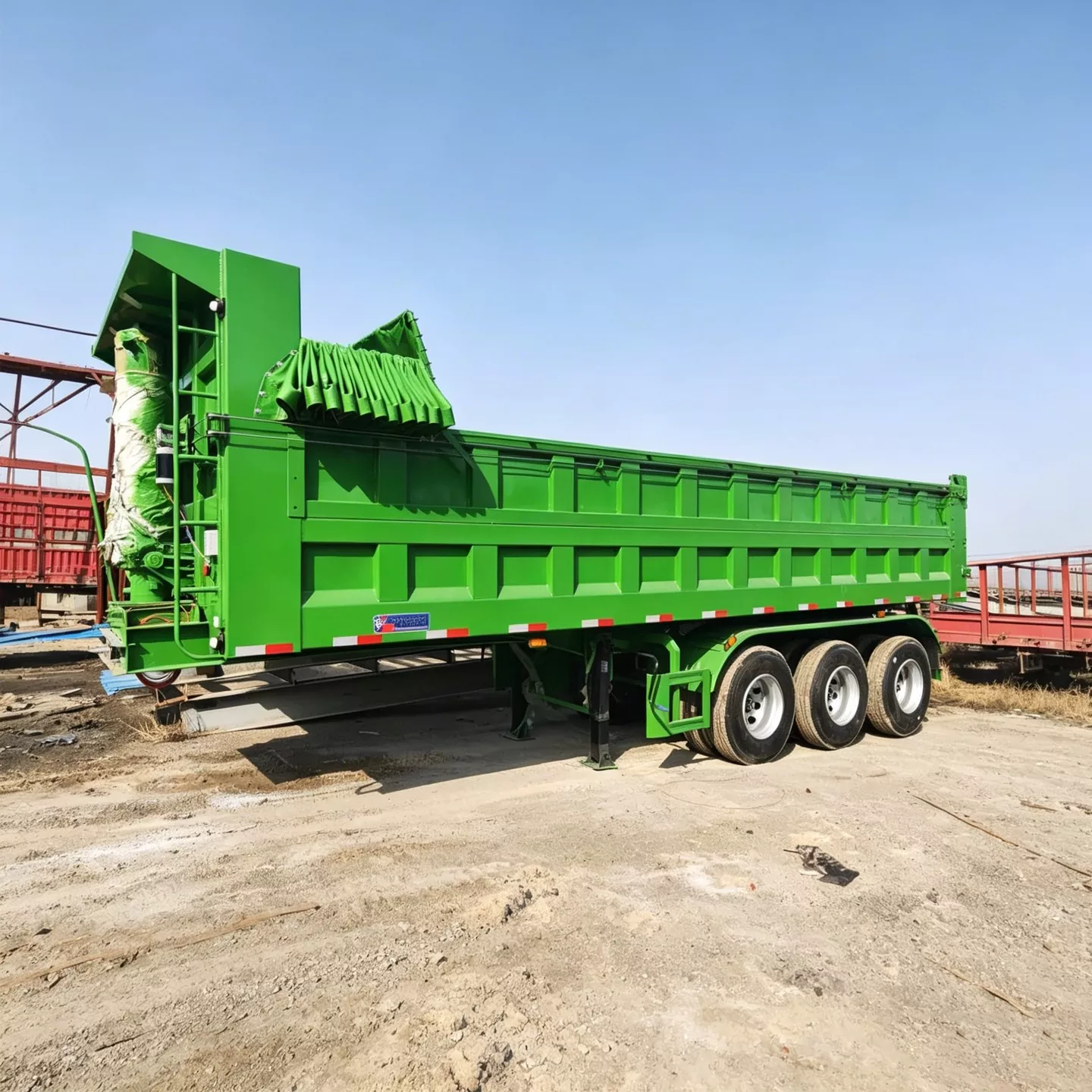
A Construction and Mining Dump Semi-trailer normally consists of several key systems:
-
Heavy-duty chassis and main beams
-
Reinforced dump body
-
Hydraulic lifting system
-
Axles and suspension
-
Pneumatic braking system
-
Kingpin and landing gear
-
Tires and wheels
-
Electrical and safety systems
The combination of these components determines the trailer's stability, service life, payload efficiency, and unloading performance.
For example, heavy materials such as ore and crushed rock can generate considerable impact and abrasion during loading. A reinforced cargo body and suitable wear-resistant materials can therefore be valuable for intensive mining applications. Hydraulic tipping systems, meanwhile, allow bulk materials to be discharged efficiently without requiring separate unloading equipment in many operating scenarios.
How Does the Dumping System Improve Work Efficiency?
One of the most important functions of a dump semi-trailer is rapid unloading. During a typical transportation cycle, the trailer is loaded, transported to the destination, unloaded, and then returned for another load. If unloading takes too long, the entire fleet becomes less productive.
A hydraulic rear-dump configuration lifts the cargo body and allows materials to slide out from the rear. This design is particularly suitable for:
-
Mining and quarry operations
-
Road and bridge construction
-
Earthwork projects
-
Aggregate transportation
-
Sand and gravel delivery
-
Construction waste handling
For projects requiring frequent transportation cycles, faster and more controlled unloading can help reduce unnecessary waiting periods and improve vehicle utilization.
What Should Buyers Consider Before Selecting a Dump Semi-trailer?
Choosing a trailer based only on nominal payload is not enough. Buyers should consider the complete operating environment, including cargo density, road conditions, tractor compatibility, unloading method, local regulations, and expected working frequency.
| Selection Factor | What to Consider |
|---|---|
| Cargo | Ore, rock, gravel, sand, soil, coal, construction waste |
| Payload | Match the trailer to legal and project requirements |
| Axles | Select according to load distribution and road conditions |
| Body | Choose suitable length, width, height, and volume |
| Steel | Consider strength, impact resistance, and wear resistance |
| Suspension | Mechanical or air suspension according to application |
| Hydraulic System | Match lifting capacity and tipping requirements |
| Braking | Select a reliable braking configuration for heavy loads |
| Tractor Compatibility | Match kingpin, dimensions, braking, and electrical systems |
The cargo body is especially important. Different materials have different densities and impact characteristics, so the body dimensions and reinforcement should be selected according to actual application conditions rather than simply maximizing volume.
Construction Dump Semi-trailer vs. Mining Dump Semi-trailer
Although construction and mining trailers share many basic principles, their operating conditions can be different.
Construction applications often involve sand, gravel, soil, aggregates, and construction debris. Flexibility, practical payload capacity, and unloading efficiency may be major priorities.
Mining applications may involve dense ore, rocks, and other highly abrasive materials. Structural reinforcement, body durability, suspension performance, and resistance to repeated impact can become more important.
In both applications, customization provides an opportunity to create a trailer that matches the actual transportation cycle.
Why Is Customization a Major Advantage?
A major advantage of working with an experienced special-vehicle manufacturer is the ability to move beyond a standard configuration. A trailer used in a quarry does not necessarily need the same specifications as one operating on a large construction project.
Shijiazhuang Jinfeng Special Vehicle Co., Ltd. focuses on special-purpose vehicle manufacturing and offers various semi-trailer solutions, including dump semi-trailers. Its product range covers multiple specialized vehicle categories, demonstrating experience in developing transportation equipment for different applications.
More importantly, project-based customization can be considered from several dimensions:
Flexible Body Customization
The cargo body can be adjusted according to material type, required capacity, loading method, and unloading environment. Options may include body length, width, side-wall height, floor configuration, reinforcement structure, and other project-specific requirements.
Customized Axle Configuration
Different payload requirements and road conditions may require different axle arrangements. Proper axle selection helps distribute cargo loads more effectively and can improve overall operating stability.
Customized Hydraulic System
The hydraulic lifting system can be configured according to the dump-body size, cargo weight, required tipping angle, and operating frequency. This is particularly important for high-frequency heavy-duty applications.
Customized Suspension and Braking
Mechanical or air suspension can be selected according to road conditions and operating requirements. Braking components can likewise be configured to meet the tractor, trailer, and applicable market requirements.
Ship-Type Customization for Special Projects
A particularly valuable advantage is the ability to support ship-type customization.
For customers with special transportation, bulk-material handling, or project-specific requirements, a standard trailer may not always provide the ideal solution. Shijiazhuang Jinfeng Special Vehicle Co., Ltd. can support customized development based on the customer's actual requirements, including special body structures and configurations inspired by or adapted to specific ship-type transportation concepts.
This customization capability allows customers to communicate their requirements before production and work toward a trailer configuration that better matches the intended application instead of being restricted to a fixed standard model.
What Results Can a Well-Matched Dump Semi-trailer Deliver?
A well-designed trailer is more than a cargo carrier. It becomes part of the project's material-handling system.
The expected operational benefits can include:
-
More efficient bulk-material transportation – A suitable cargo capacity helps move appropriate quantities per trip.
-
Faster unloading – Hydraulic tipping simplifies the discharge of loose materials.
-
Better adaptability – Customized dimensions and components can suit different project environments.
-
Improved durability – Reinforced structures can be selected for demanding applications.
-
Better fleet compatibility – Trailer specifications can be matched with existing tractors.
-
Greater project flexibility – Special configurations can be developed for unusual transportation requirements.
For mining and construction companies operating continuously, these advantages can contribute to smoother transportation cycles and more predictable daily operations.
How Can Shijiazhuang Jinfeng Build the Right Solution?
The ideal Construction and Mining Dump Semi-trailer should begin with the application rather than a catalog specification. Before production, customers can provide information such as:
-
Material to be transported
-
Expected payload
-
Tractor model
-
Road and terrain conditions
-
Required trailer dimensions
-
Dumping direction
-
Working frequency
-
Local transportation regulations
-
Special customization requirements
Based on these factors, the trailer configuration can be developed around the customer's actual project. This application-oriented approach is particularly useful when customers require non-standard dimensions, reinforced bodies, special unloading structures, or ship-type customization.
With its focus on special vehicles, Shijiazhuang Jinfeng Special Vehicle Co., Ltd. can be a practical partner for businesses seeking customized dump semi-trailer solutions for construction, mining, quarrying, and other heavy-duty transportation applications. Its patent record also shows involvement in special-vehicle technology development.
Conclusion
A reliable Construction and Mining Dump Semi-trailer needs to balance payload, structural strength, hydraulic performance, stability, durability, and operational flexibility. The best solution is not necessarily the trailer with the largest capacity, but the one properly matched to the cargo, tractor, road conditions, unloading requirements, and project environment.
For buyers requiring more than an off-the-shelf configuration, customization can make a significant difference. From cargo-body dimensions and axle arrangements to hydraulic systems and ship-type customization, Shijiazhuang Jinfeng Special Vehicle Co., Ltd. can help develop special-vehicle solutions around specific transportation requirements.
If you are looking for a durable dump semi-trailer for mining, construction, quarrying, infrastructure, or a specialized project, contact us to discuss your cargo requirements, operating conditions, dimensions, and customization needs. Let Shijiazhuang Jinfeng Special Vehicle Co., Ltd. help you develop a Construction and Mining Dump Semi-trailer designed around your real-world application.